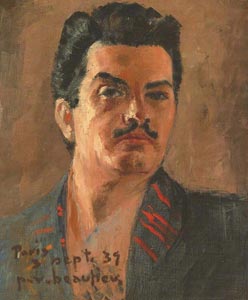
P.V. Beaulieu, self-portrait, 1939
BIOGRAPHY
Born in Montreal in 1910, Paul-Vanier Beaulieu studied two years at the Ecole des Beaux-Arts, Montreal. He then worked in a Montreal Café until he had sufficient money to travel to Paris in 1938. He purchased a studio in Montparnasse, Paris.
Beaulieu and other Canadians were interned at Fresnes, France, during the Second World War, from 1940 to 1944. He returned to his studio at the cessation of hostilities and, in 1952, he made 30 etchings for J.L. Vallas book of poems O Visages.
A serious minded artist with little patience with repetitive formulas in painting, he sold most of his work in Canada and accompanied all shipments to Montreal.
After living and painting for 30 years in France, Beaulieu came back to Canada and settled in the Laurentians, North of Montreal, where he died in 1995.
SUBJECT
Beaulieu painted landscapes, figures, and still-lifes in semi-abstract and modernistic styles.
TECHNIQUE
Particularly interested in form and design, he applied his paint liberally with a palette-knife and brush in bright colours. Dorothy Pfeiffer, a Montreal art critic, once wrote in the Montreal Gazette; “... his work is suffused with a subtle and romanesque love of colour.”
Beaulieu’s media include oils, watercolours, lithography and etching. Paul Duval referred to his etchings as “crisp” and used the artist’s aquatint entitled “Illustration” for an example in his book on drawings and prints.
EXHIBITIONS
Paul-Vanier Beaulieu has exhibited in Quebec, Toronto, New York, Mexico City, Rio de Janeiro, and other centres. He is represented in major Canadian Museums, the Bezalel Museum in Jerusalem, and the Museum of Modern Art in Paris.


